
How Has the U.S. Constitution Been Eroded Over Time? A Beginner's Overview
Dale Porter · September 13, 2026 · 5 min read
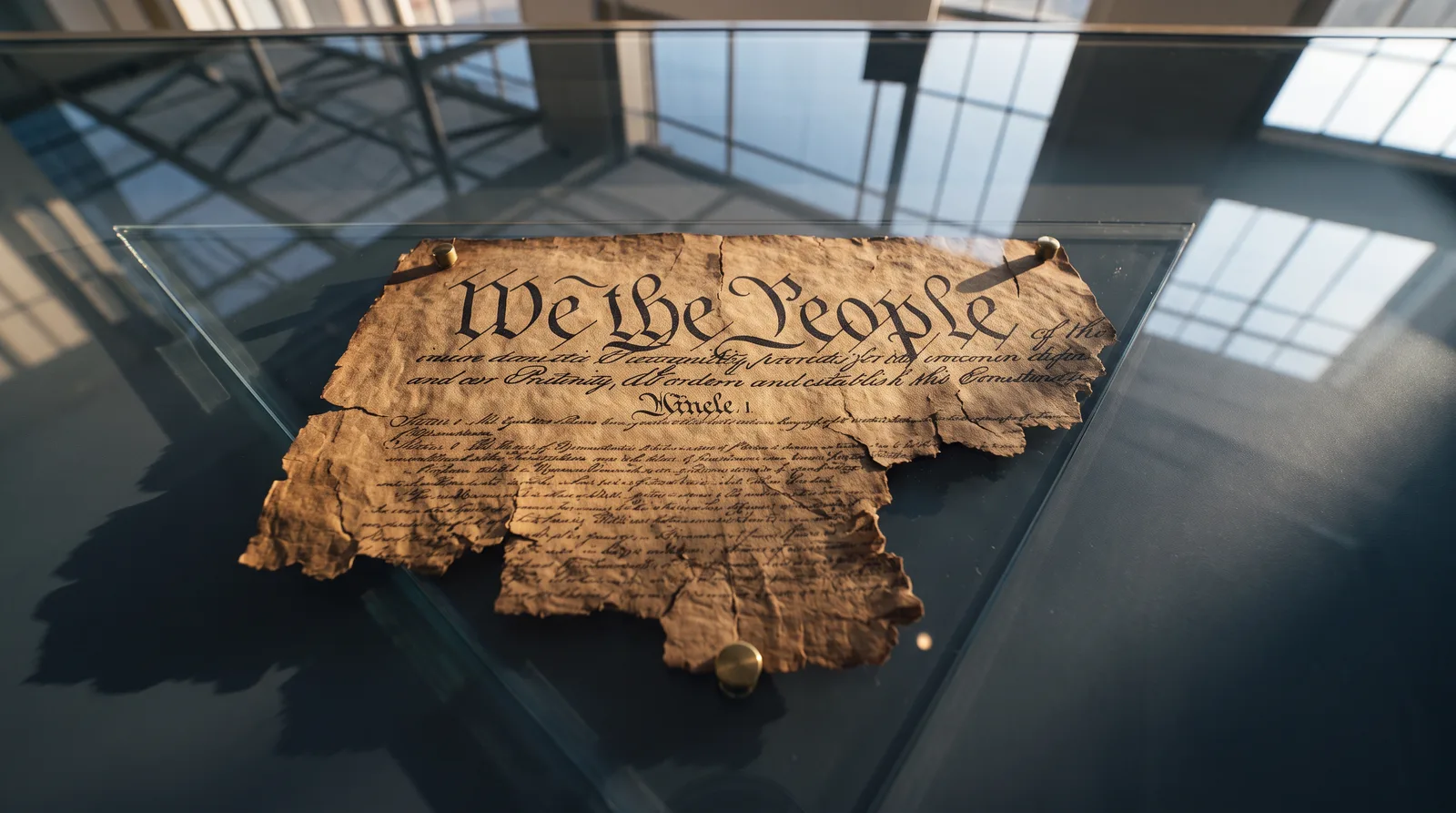
Most people imagine that if the Constitution were ever seriously undermined, it would look like a dramatic rupture — a coup, a crisis, an obvious before-and-after. The harder truth is that constitutional erosion almost never works that way. It works the way a river reshapes a canyon: slowly, consistently, and so gradually that most people don't notice until the landscape has completely changed.
If you want to understand where American governance stands today, you first have to understand how it got here. That means tracing three distinct mechanisms — executive overreach, unconstitutional legislation, and judicial reinterpretation — and recognizing how each one feeds the others.
The Architecture the Framers Built
Before you can understand erosion, you need a baseline. The Framers didn't design a democracy in the pure sense. They designed a constitutional republic with separated powers, enumerated limitations, and a built-in distrust of concentrated authority. Article I gave Congress the legislative power. Article II gave the executive the power to carry out law — not to make it. Article III created a judiciary to interpret the law, not to legislate from the bench.
The Tenth Amendment made the philosophy explicit: powers not delegated to the federal government by the Constitution are reserved to the states or to the people. That's not a footnote. That's the load-bearing wall.
Mechanism One: Executive Overreach
The executive branch was always going to push for more authority — that's the nature of power. But several moments stand out as turning points.
The use of executive orders as a tool of policymaking — rather than a tool of administration — accelerated significantly in the twentieth century. An executive order is constitutionally appropriate when it directs how the executive branch carries out existing law. It becomes overreach when it effectively creates law that Congress never passed.
Similarly, emergency powers were designed for genuine, narrow crises. Over time, declared emergencies have stretched to cover situations that persist for years or decades, with little congressional check. When emergency becomes the default mode of governance, the exception swallows the rule.
Mechanism Two: Unconstitutional Legislation
Congress itself has been a vehicle for erosion — sometimes through honest miscalculation, sometimes through deliberate expansion. The key concept here is enumerated powers. Article I, Section 8 lists what Congress is authorized to legislate on. It is a finite list.
The Commerce Clause — which gives Congress the power to regulate commerce among the states — has been stretched so far from its original meaning that it has been used to justify federal regulation of activities that are neither commercial nor interstate in any recognizable sense. What began as a provision to prevent states from erecting trade barriers against each other became, over the course of the twentieth century, a catch-all justification for sweeping federal authority.
The General Welfare Clause has been similarly expanded. The Framers understood "general welfare" as the welfare of the nation collectively — not a blank check for any spending program any Congress wanted to fund.
Mechanism Three: Judicial Reinterpretation
The judiciary was meant to be, in Alexander Hamilton's words in Federalist No. 78, the "least dangerous branch" — the one with neither the sword nor the purse. Its job was to apply the Constitution as written.
But judicial interpretation is not a neutral act. When courts adopt a "living Constitution" philosophy — the idea that constitutional meaning should evolve with changing social conditions — the written text becomes a flexible instrument rather than a fixed standard. The practical result is that constitutional boundaries can be redrawn by five unelected justices without a single amendment ever being passed.
That matters enormously. The Constitution has an amendment process — Article V — precisely because the Framers knew future generations would need to adapt the document. That process requires broad consensus: two-thirds of Congress and three-fourths of the states. It's deliberately difficult. Judicial reinterpretation allows the same practical effect to be achieved without any of that democratic accountability.
Why These Three Work Together
The most important thing to understand is that these three mechanisms are not independent. They reinforce each other. Congress passes a broad law; the executive issues regulations that expand its scope far beyond what the text says; the courts defer to the executive's interpretation. Each branch lends legitimacy to the others' overreach, and the enumerated limits in the Constitution quietly lose their teeth.
This is what constitutional erosion actually looks like in practice — not a single villain, not a single moment, but a slow, compounding process that takes generations to fully materialize.
Where to Go From Here
Understanding the erosion is the first step. The more important question — and the more interesting one — is what a genuine constitutional restoration would actually require. That means going back to the text itself, amendment by amendment, clause by clause, and understanding what it says in plain language before deciding what to do about what it doesn't say anymore.
That's exactly what we work through together in the Plain Text Constitution course and the Fraternal Order of Continental Sentinels Constitutional Republic Studies program. If you want to move from a general sense that something has gone wrong to a precise, grounded understanding of what the Framers actually built — and what it would take to restore it — that's the place to start.
The Constitution was written to be understood by ordinary citizens. You don't need a law degree. You need the text, the history, and someone willing to walk through it honestly. Let's do that.